Resting On Grace
Faith doesn't do anything; it simply enables us to relate ourselves to someone else who has already done whatever needs doing. - Robert Farrar Capon

Romans 4.13-25
For the promise that he would inherit the world did not come to Abraham or to his descendants through the law but through the righteousness of faith. For if it is the adherents of the law who are to be the heirs, faith is null and the promise is void. For the law brings wrath, but where there is no law, neither is there transgression. For this reason the promise depends on faith, in order that it may rest on grace, so that it may be guaranteed to all his descendants, not only to the adherents of the law but also to those who share the faith of Abraham (who is the father of all of us, as it is written, “I have made you the father of many nations”), in the presence of the God in whom he believed, who gives life to the dead and calls into existence the things that do not exist. Hoping against hope, he believe that he would become “the father of many nations,” according to what was said, “So shall your descendants be.” He did not weaken in faith when he considered his own body, which was already as good as dead (for he was about a hundred years old), and the barrenness of Sarah’s womb. No distrust made him waver concerning the promise of God, but he grew strong in his faith as he gave glory to God, being full convinced that God was able to do what he had promised. Therefore it “was reckoned to him as righteousness.” Now the words, “it was reckoned to him,” were not written for his sake alone but for ours also. It will be reckoned to us who believe in him who raised Jesus our Lord from the dead, who was handed over for our trespasses and was raised for our justification.
1981 was a pivotal year. It marked the beginning of the Reagan Presidency, the marriage of Prince Charles to Lady Di, and the Indiana Jones film franchise. It was also a year of tremendous tumult; Reagan was shot just months into his presidency, Pope John Paul II (or, as he’s known among cool Catholics and mediocre Methodists: JP2), was also shot by a would-be assassin; there was political upheaval across the world, economic instability, and vitriolic violence.
But here, 45 years later, it’s clear that one particular event from 1981 stands out among all the rest.
In October of 1981, with the world reeling from the roller coaster of frenetic change, the American rock band Journey released their mega hit single “Don’t Stop Believin’”
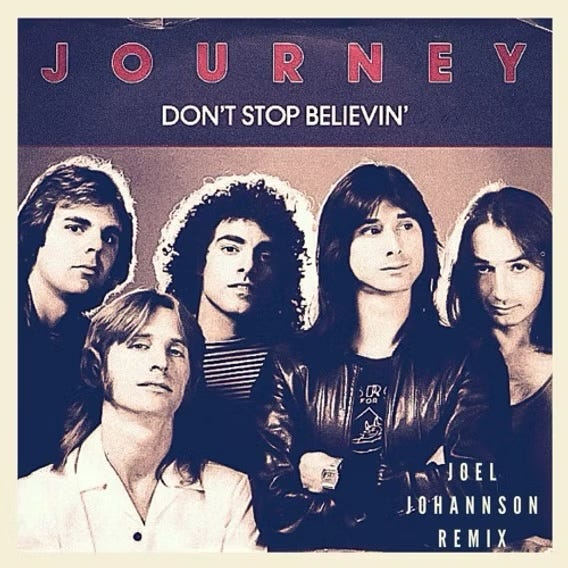
Do you know the song?
(I wrote this before discovering that Journey actually played a show at the Berglund Center here in Roanoke on Thursday night.)
“Don’t Stop Believin’” is a mid-tempo rock anthem and power ballad that defies conventional song standards by withholding the chorus until the very end of the song. It is marked with arpeggiotic electric guitar riffs, a driving synthesizer, and Steve Perry’s mellifluous high tenor vocal runs.
If you want to time travel back to the early 80s, just listen to these words:
“Just a small town girl, living in a lonely world. She took the midnight train going anywhere. Just a city boy, born and raised in South Detroit. He took the midnight train going anywhere.”
Chances are you can hear the rest of it in your heads right now without me singing the rest because it was, and is, super duper popular. It is piped in at sporting events when the home team needs to turn it around, it is butchered at Karaoke Bars on the regular, and it was even the center piece of the television show Glee.
So why am I preaching about Journey’s smash hit from 1981?
There are two kinds of faith. They sound remarkably similar but they are actually very different. The first kind of faith is the desire to have a kind of certainty or conviction that can sustain us during time of doubt or despair. It’s like getting pumped up before a game, a test, or a challenging conversation. It’s an action we do in order to get ourselves through.
This kind of faith is most associated with the word believe. We all believe all sorts of things. But this type of faithful belief looks like rooting ourselves in certain rituals or ideas that may seem bewildering to other people but we believe that our beliefs actually make a difference in this world.
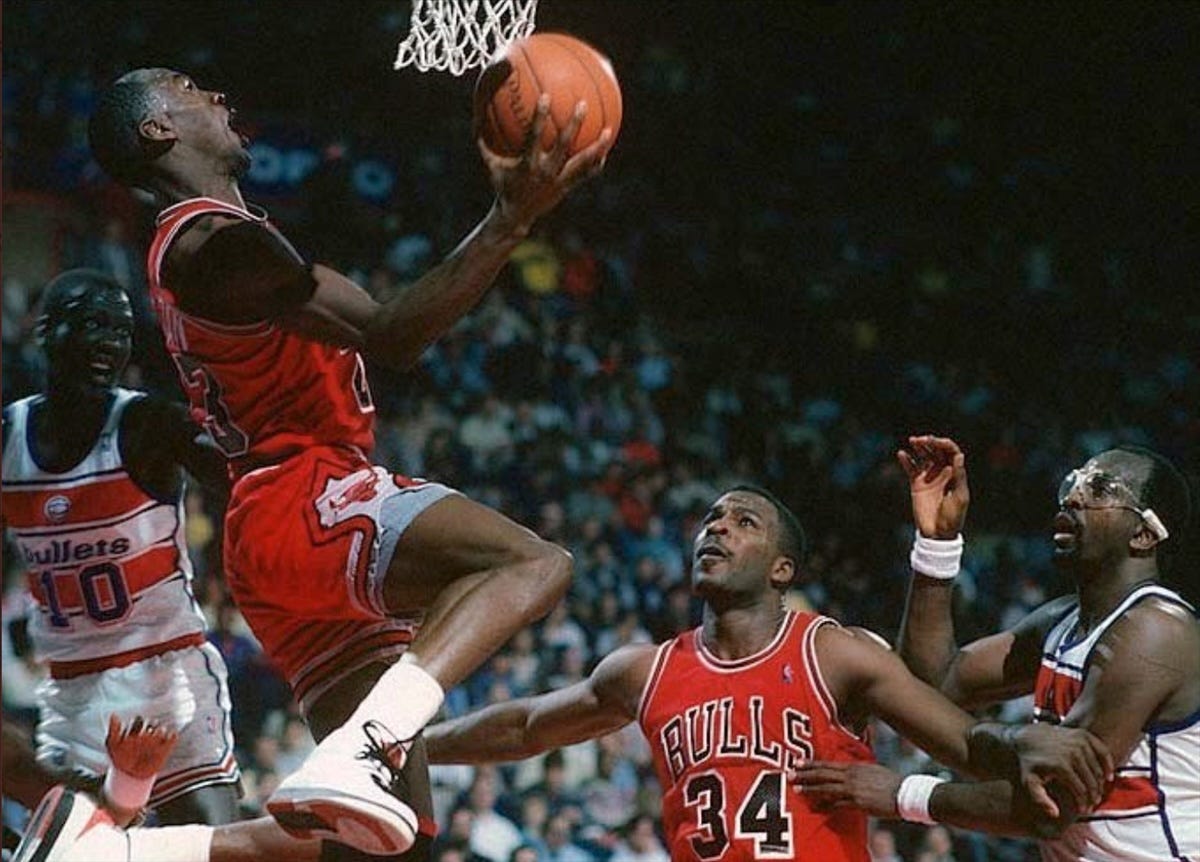
So, for instance, the great Michael Jordan, despite all of his years of experience and practice, played every single basketball game while wearing two pairs of shorts. Whether he was plays for the Bulls or the Wizards, he always wore his old pair of UNC shorts underneath. Why? Because he believed that by doing so he would play better.
For the rest of us, we also hold these kind of beliefs and not just superstitions. To keep belief at work, we tend to surround ourselves with people who hold similar convictions so that, with solidarity, we can lift ourselves out of the mundane where everything tends to feel fragile and tenuous. Thus our beliefs become a source of our identity, which of course helps us to discover who we want to be with and who we don’t want to be with.
And all of these different beliefs convey some form of escape. We believe by believing we can experience something better than what we’re currently experiencing.
Hence the anthemic nature of “Don’t Stop Believin’” Just hold on to that feelin’
It’s all about agency.
But, there is another kind of faith, and its not built on escape.
Here’s a helpful illustration from Robert Farrar Capon:

Imagine you’re in the hospital, in traction, with casts on both arms and both legs. And every time someone comes to visit you, you can’t help but complain about the experience. After all, you’re stuck in bed, the food is okay but not great, and there are so many things you need to be doing at the house. The paint is peeling, the sills are rotting, and the roof is blowing away in the wind.
But then, one day, a friend comes back to visit with you and says, “I went ahead and called a contractor and paid upfront for all the repairs at you house. It’s a gift from me to you.”
What are your choices in that moment when you are handed such good news? You can’t leave the hospital to check for yourself, you can’t know whether or not this is actually true.
So you can either have faith in your friend, or not.
If you don’t have faith in your friend, then you can just go on being and feeling miserable in the hospital. But if you have faith in your friend, if you trust them, then you will have the first good day you’ve had in a long time.
Faith, Capon says, doesn’t do anything; it simply enables us to relate ourselves to someone else who has already done whatever needs doing.
There are two types of faith - belief and trust. One is active and the other is passive. Trust doesn’t assume that life is about us overcoming our limitations. Instead it’s about finding truth, beauty, wonder, delight, and friendship in the midst of our limitations. Sam Wells writes that, “Trust doesn’t pretend that if you hold tight to the right things, nothing will ever go wrong - it inhabits the exercises and patience required to rebuild after matters have been strained or broken.”
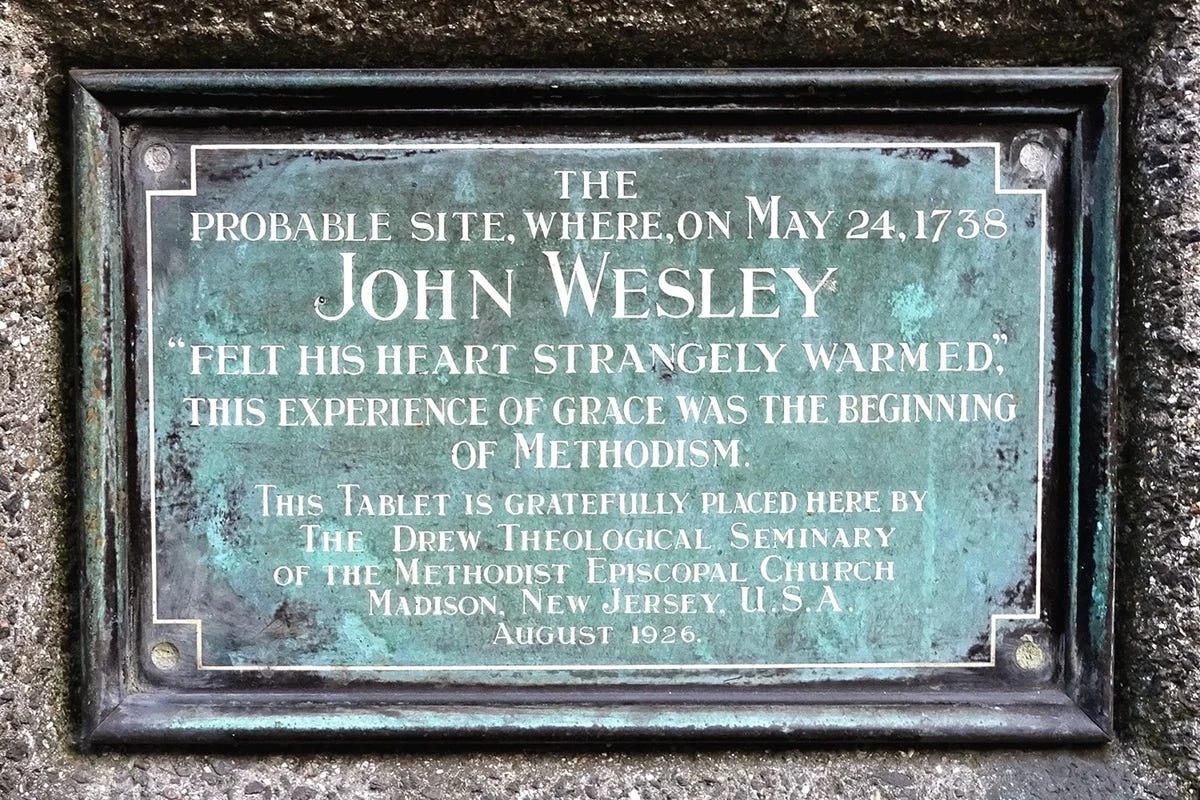
On May 24th, 1738, a young British clergyman was wandering the streets of London with nothing but doubts and fears weighing down his heart, mind, and soul. He was raised in a faithful family and he had done all the right things; he went to the right school, he knew the right scriptures, he prayed the right prayers. But it wasn’t enough.
For, no matter how hard he prayed, no matter how many spiritual disciplines disciplined him, it always felt like something was missing. In short, his faith wasn’t very faithful.
In fact, just days before he had confided in a friend and said, “How can I preach faith if I don’t have it?” And his friend said, “Just keep preaching faith until it finds you.”
Nevertheless, he wandered the streets in London with a longing for something he did not have.
It’s a feeling that is all too familiar to some if not all of us. On the surface everything is as it should be, but underneath its just a mess. It’s putting in the time and the work but the results aren’t there. It’s a never ending email inbox of reminders that you’re not enough. …
It’s the feeling of doing all the right things, but nothing feeling right.
And so, on that fateful evening in 1738, the young preacher reluctantly attended a meeting that was happening on Aldersgate Street. And miracle of miracles, everything changed.
His name was John Wesley and without that night we wouldn’t be sitting in this church. And we know what happened because Wesley scratched it all out in his journal right after.
“Someone was reading from Martin Luther’s Preface to the Epistle to the Romans and while he was describing the change with God works in the heart through faith in Christ, I felt my heart strangely warmed. I felt I did trust in Christ, Christ alone for salvation; and an assurance was given me that God had taken away my sins, even mine, and saved me from the law of sin and death.”

In that moment Wesley’s faith went from belief to trust. He went from assuming salvation was up to him to realizing that salvation come by Christ alone.
And that difference makes all the difference. It’s that conviction that led to the Methodist movement to reform the church and eventually started a whole new denomination that is primarily and unashamedly focused on God’s grace.
This same distinction between belief and trust is at the heart of Paul’s argument in Romans 4. We tend to focus on Abraham’s faith, his agency, his willingness to be a stranger in a strange land. But that’s not the way the strange new world of the Bible sees it.
In Genesis 12, God speaks to Abraham and says, “Go from your country and your people and your father’s house to a land that I show you. And I will make of you a great nation, and I will bless you and make your name great so that you will be a blessing… and by you all the nations of the earth will be blessed.”
Did you notice who gets all the good verbs? God! It’s less about a command and more about a promise. It’s not transactional and it’s not conditional.
There are no “ifs” in the kingdom of God.

At no point in the Biblical witness does Abraham do anything to earn the honor bestowed upon him by God. In fact, he does a lot to call into question whether or not he should be the one blessed. But the covenant is not contingent upon Abraham’s ability to keep it. The only thing Abraham really brings to the equation is trust.
Paul says that Abraham is righteous not because of his goodness or virtue or morality, but because God reckons him righteous. God makes Abraham righteous by grace.
This is why, to quote Paul again, the Law brings wrath but the Gospel sets free. Doing all of the right things and knowing all the right people and making all the right choices can’t make us right. We all fall short of the glory of God, we all waver, we all mess up, we all neglect to do the things we should and we tend to do a bunch of things we know we shouldn’t.
We’re not a bunch of good people getting gooder all the time. We’re actually a bunch of humans (who by definition make mistakes) who just happen to have the good fortune of a community that says we are welcome simply because we are who we are.
It never ceases to amaze me how weird and wonderful the church is. There is nowhere else you can find a more truthful community of people who are willing to see more than the world sees, who are willing to put our trust in the only One who can actually do anything about anything.
Faith can look like belief and it can look like trust. And here’s the funny part: God’s faith in us is belief. It’s far-fetched, irrational, and beguiling. There’s no good reason for God to put faith in us because we’ve been messing it up since Eden. But everything depends on God’s believing in us.
And our faith in God is trust. It’s saying something like, “I know that I don’t know what’s going to happen, only that God is with me along the way.”
When we think faith is only about believing, we tend to beat ourselves up whenever we doubt, or wonder, or question what we believe. But that’s not really what faith is all about. Faith is about trust. It’s about Jesus coming to us in our need and saying he’s got us.
It all rests on grace.
So don’t worry if you feel like your faith is fleeting or it’s only the size of a mustard seed. Jesus says that’s all the faith we’ll ever need.
Why? Because faith isn’t something we do, faith is like a seed planted in us that when it grows, it becomes the difference that makes all the difference. Amen.