
Help!
The Gospel is a promise that the worst thing is never the last thing.

1 Peter 4.12-14, 5.6-11
Beloved, do not be surprised at the fiery ordeal that is taking place among you to test you, as though something strange were happening to you. But rejoice insofar as you are sharing Christ’s sufferings, so that you may also be glad and shout for joy when his glory is revealed. If you are reviled for the name of Christ, you are blessed, because the spirit of glory, which is the Spirit of God, is resting on you. Humble yourselves, therefore, under the mighty hand of God, so that he may exalt you in due time. Cast all your anxiety on him, because he cares for you. Discipline yourselves, keep alert. Like a roaring lion your adversary the devil prowls around, looking for someone to devour. Resist him, steadfast in your faith, for you know that your brothers and sisters in all the world are undergoing the same kinds of suffering. And after you have suffered for a little while, the God of all grace, who has called you to his eternal glory in Christ, will himself restore, support, strengthen, and establish you. To him be the power forever and ever. Amen.
In 2020 a Dartmouth College researcher named David Blanchflower made international headlines when he published a report compiling a massive amount of data from 132 countries across the globe. Blanchflower discovered that, across cultures, demographics, and even time periods, life satisfaction universally takes on a U scape. The U-Bend of Happiness. It bottoms out at 47.2 years of age.
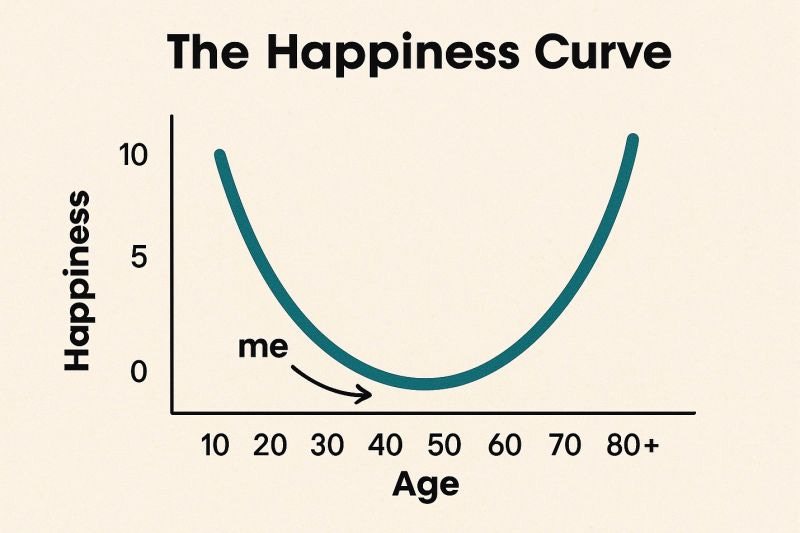
The theory put forth by Blanchflower is that the least happiness experienced is during the so-called “sandwich stage” of life. Its when parents are caring for children and their own aging parents. It’s when work responsibilities hit their peak. It’s also when most couples who separate, separate. It’s when adults who have enjoyed their abled bodies start to realize they’re no longer able to do everything they once did. It’s when hair changes color or completely disappears. And so on.
According to Blanchflower it all has to do with perspective and expectations. Expectations are high when we are children because every possibility is still a possibility. But with every passing year the open-ended nature of the future begins to diminish. Maybe you thought you were going to be an astronaut but you didn’t have the right grades, or you thought you’d travel the world but then you got a mortgage, or so many other things.
And it all hits rock bottom at 47.2 years of age.
But then a funny thing happens. Once we make it to the other side, our expectations are recalibrated. We no longer lament the limited notion of the future but are instead grateful for everything. Our responsibilities lesson. Our worries diminish. And by the end, we are as happy as we were at the beginning.
Who knew that the Happiness Curve would take form in the shape of a smile?
And of course, this U-Bend may be universal, but it hits us all differently.
You may be far from bottoming out on the younger or more seasoned side, perhaps you know all the current dance moves or you can still kick it on the dance floor without needing an ibuprofen, but then a friend will call who just got kicked to the ground with a medical diagnosis.
Or maybe you have the perfect and fulfilling job, but your spouse might realize they don’t, and the question will come to the surface about what should happen next.
Or maybe you’ve got friends who love to come over for dinner, but then they get busy and you get busy and before you realize it you can’t remember the last time you sat down for anything.
The bottom comes for us all, and it doesn’t even have to arrive in middle age.
For what it’s worth, Blanchflower has noted that the happiness curve is actually starting to skew in the wrong direction among the young. Basically, this U shape has transcended time until recently because young people are not as happy as young people were a decade ago. And there’s a direct correlation between happiness and the amount of time spent with other people, and unhappiness and the amount of time spent on devices.
Which means even if we’re not 47.2 years old, chances are we could use some relief; relief from the anxieties of life.

Jesus is doing his Jesus thing. He waxes poetic with various parables, he heals the sick, brings hope to the hopeless, and love to the unlovable. But, despite the growing crowds wherever he goes, the people can’t quite understand, grasp, or believe what he says and does.
When Jesus’ cousin John came and started baptizing in the Jordan, he was rejected for being “too holy”, neither eating or drinking the kinds of things that normal people eat and drink. But now, Jesus’ words and actions are tossed aside, ridiculed, and derided because he’s not holy enough. Chief among all the complaints lobbed at Jesus is that he eats and drinks with tax collectors and sinners. The people call Jesus a glutton and a wine-bibber.
And after receiving such accusations Jesus addresses the crowd, with all their hopes and doubts, and he says, “Come to me, all you that are weary and carrying heavy burdens, and I will give you rest.”
It’s no wonder we call the Good News good.
Jesus says, “I’m not here for the put together and the perfect. Those who are well have no need for a physician. But to those who are unwell, who ache for something more, who can barely lift their chins, the worried, the anxious, the last, least, lost, and little, for those who are 47.2 years old, the Son of Man comes to make a way where there is no way. I have come to set free those who are oppressed, to proclaim a new day and a new way.”
Later, after the death and resurrection of the One who brings rest to the weary, Peter takes up the same Gospel message as he pens an epistle to the church.
Listen, again, to what Peter writes: Cast all your anxieties on the Lord, because God cares for you.

The word for anxiety here in Greek is μέριμναν, and it’s the same word Jesus uses in the Parable of the Sower, a parable in which Jesus warns his disciples that the anxieties, or the worries, of this world threaten to choke off the grace that God sows in the world.
The world has plenty of so-called remedies for this, some of which do help, from yoga to therapy to medication. All good gifts. But being told to do something does not guarantee that we will do it. Exhortation can lead to what the word sounds like, hot air.
And even Peter’s letter sounds like he’s offering his own solution to stress, because it seems like it requires us to do something. Among all the other somethings we’re supposed to do. But the doing we do is nothing more than laying out our worries and asking for help. Which, of course, may also be the most difficult thing we ever do. But, help is fundamentally predicated on the presumption that we need someone to do for us what we can’t do for ourselves.
Paul Zahl says the most basic definition of prayer is that one word: Help. Casting our anxieties on the Lord is asking for help. (And what could be more counter-cultural than that!)

And, we can trust Peter with this Word because he is no stranger to anxiety himself! He knows how the burdens of the world can choke out the seeds of grace sown by the Lord. Seeing Jesus walk on water leads to Peter jumping straight in, only to start floundering when his worries kick in. Peter is also stuck on earthly thinking and nervousness when Jesus predicts his own passion. In the Garden of Gethsemane its Peter’s fear that leads him to try to protect Jesus by raising the sword that Jesus tells him to put away, forever.
And that’s not even mentioning the anxiety of denying that he will deny the Lord no less than three times.
Peter knows better than most that being commanded to fix our anxieties only leads to more anxieties.
But notice, Peter isn’t giving advice. And despite the commanding nature of his command to cast our anxieties on Jesus, it’s Gospel rather than the Law, it’s a promise more than an exhortation.
Why? Because Jesus cares for you. You.
Jesus has already taken away all your sins, nailed them to the cross, and left them there forever. His perfect righteousness is now yours for free. And the same Lord who goes to the cross for you and me is still at work in you and in me.
Just look around, Jesus has given you the gift of this church. People who know you, and people who don’t, who are willing to show up for you on the mountaintop and in the valley. People who will not judge you for bringing laughter or tears to worship. People who will ask you questions that no one else will. That’s the Holy Spirit moving in and among us.
The church is Christ’s body for the world which means that, at times, casting our anxieties on the Lord means placing them on his body, the church. There’s a reason scripture speaks of weeping with those who weep. There’s a reason the first step in recovery is admitting we need recovery, of joining with others on the same road for the same type of journey. There’s a reason Christ’s inaugurates this strange new reality we call the church where strangers now are friends.

And Christ is also at work outside the church. Did you notice that the sun came up today? We, all of us, have been given a new day, a day with wild and wonderful possibilities! That’s a miracle in and of itself!
Have you listened to the birds recently? Or considered the lilies? Jesus asks us to do so not just because it’s nice, and it is nice, but it also helps to give us perspective. It opens our eyes to something more than whatever is currently weighing us down.
The Gospel is a promise. Jesus cares about you, desires your welfare and your gladness. You can give him your worries, by prayer, by exhaustion, by friendship, by worship, by any and all means necessary because he cares for you.
Jesus is for you no matter what.
If you’ve ever been made to think you’re somehow not worthy of Jesus’ attention or affection, if the world has ever worked to diminish you or belittle you, just remember that the accusation lobbed against Jesus the most is that he spent too much time with the wrong people.
People just like you and me. Jesus is the friend of sinners and the Savior of the world. There is no one outside the power of his grace, because Jesus is never done with anyone.
The promise of the Gospel is that Christ has died, Christ is risen, and Christ will come again. We live, therefore, in the difference Christ makes.
That’s a promise, though it’s not necessarily a solution.
Because Peter doesn’t say when we cast our anxieties they all go away. No, life will always give us more. But God can handle it. God can handle all of it.
No matter what cares and worries we’re carrying, or are holding on to us, no matter where we find ourselves on the U-Bend of Happiness, the living God, the God who sows grace all over the place, is at work to restore you, support you, strengthen you, and enliven you.
Sometimes it arrives in the form of a friend who shows up when we need it most, or a song that pulls us out of the pit, or a prayer that prays the words we feel but can’t quite articulate.
Sometimes it arrives in the unexpected sound of laughter, the smell of rain, or the feeling of the sun on our skin.
Sometimes it arrives in our homes around the table, out in the quiet of the woods, or even in the midst of Christ’s body the church.
We can cast our anxieties onto Jesus because the promise of the Gospel is that the worst thing is never the last thing. Amen.